Gies Business is developing the iBlock Prediction Market, a campus platform where students can learn how prediction markets work using digital tokens instead of real money. The project brings together the Derivatives and Trading Academy, the Disruption Lab, and Illini Blockchain.
NOTE: This educational platform uses digital tokens only; no real money is used. Students also must complete the required educational materials before participating.
If you’re preparing students to succeed in the current business world, you’re already behind, says Rich Excell, clinical assistant professor of finance and director of the Derivatives and Trading Academy at Gies College of Business. “You don’t want to skate to where the puck is,” said Excell, using a quote often attributed to hockey great Wayne Gretzky. “You want to go where the puck is going to be.”
According to Excell, the puck is clearly going toward prediction markets, which is why he’s partnering with the Disruption Lab and Illini Blockchain to launch an exciting new prediction market platform designed to help Gies Business students improve their financial acumen.

“Having our own prediction market in Gies will help our students differentiate themselves from other universities in two ways,” said Excell, who believes Gies Business is the first business school with its own prediction market. “First, this is a low-stakes way for students to get experience trading these types of markets, which are event contracts that trade differently than public markets. Second, Derivatives and Trading Academy students will get practical hands-on experience in market-making. There is no other way for a student to get this practical experience, and it sets them up well for careers in this field.”
If you’ve heard of Kalshi or Polymarket, you’re probably already familiar with prediction markets. The popular apps allow people to “trade on anything,” using event contracts to take positions on topics ranging from sports to weather-related events. Unlike traditional markets, prediction markets are uniquely binary. Teams either win or they don’t. Candidates are elected or they aren’t. To succeed in this new trading arena, students need to learn how to price binary outcomes appropriately. And the Derivatives and Trading Academy is the perfect place to teach that.
Launched in 2024, the academy offers a rigorous, hands-on program designed to prepare high-performing students for exciting careers in trading, derivatives, and quantitative finance. It provides a rare combination of teaching students not only academically what they need to know about derivatives, but also offers them platforms and challenges to trade it. Faculty feedback is built into the program, so students aren’t just participating in challenges and hoping for the best; instead, they’re honing their skills, learning from expert feedback, and developing long-term, consistent success.
The Derivatives and Trading Academy is one of seven academies at Gies Business that enable students to take a deep dive into specific areas of interest. Students find advanced opportunities to learn from experts and industry leaders and then apply what they have learned in real-world applications. They develop the skills, mindset, and experiences needed to gain a competitive edge and create value in a rapidly evolving business world. Along the way, they create their own story about what they know and what they’ve accomplished – and learn to share it in a compelling way.
“The Derivatives and Trading Academy is a three-semester program, and each semester you have trading challenges,” said Sam Sathiaraj, a senior majoring in finance and data science and one of the two student leads working on the project. “You learn by doing it, you understand how risk management works, and you understand a lot of things people usually pick up in their first job, which puts you ahead of the curve.”
The Derivatives and Trading Academy at Gies Business offers a rare combination of a dedicated undergraduate cohort, a three-semester sequence focused on derivatives and trading, and student strategy development and backtesting. [LISTEN: Derivatives & Trading Academy students recently appeared on the Options Insider podcast]
Soon, prediction markets will be a part of that learning experience, thanks to Excell, who spotted the growing trend while talking with industry contacts. “I could see from my discussions with trading firms, market makers, prop traders – even investment banks and different parts of the trading world – that there was a lot of capital being directed toward prediction markets and new jobs.”
Building a market for campus
It was a hot topic on campus as well. Excell equates it to 2021, when meme stock investing was all the rage and a fear of missing out led many students to make risky financial decisions. By creating a closed prediction market trading platform where students traded with digital tokens instead of real currency, Excell believed he could help students learn while eliminating the financial risks. He just had to build it.
“I remembered I was part of the first blockchain conference at Gies Business a few years ago,” said Excell. “So I reached out to Robert Brunner, professor of accountancy and chief disruption officer at Gies Business, and said, ‘Hey! I’ve got this idea. Prediction markets are a really big thing. Prediction markets are built on blockchain. We have a blockchain. Why don’t we build our own prediction market?’” Brunner linked him with Adam King and Jamie Nelson at the Disruption Lab, and they put the ball in motion.
The Disruption Lab is a unique Gies Business student program exploring opportunities at the intersection of business and emerging technologies. Students in the program work with the latest technology, including AI, blockchain and cryptocurrency. Sometimes they consult with outside companies, providing research for startups and major companies like AMD. And sometimes they help faculty bring exciting innovations to the classroom. Either way, they gain invaluable experience, working with – and learning from – students in engineering and data science.
“You learn so much by being hands-on and actually working with clients on these cutting-edge projects,” said King, director of Innovation and Transformation at Gies Business. “And for students, it’s great, because they can leverage those experiences when they’re applying for internships. We’ve had several instances where students told us, ‘This project is the reason I got a full-time offer.’”
While the program is housed within Gies Business, it’s quickly developed a reputation as the premier computer science lab on campus. That makes it a powerful draw for students like Sahib Bedi, a junior majoring in finance and accounting, who currently co-directs the lab’s strategic wing and enjoys taking on technical challenges.
Bedi worked with Sathiaraj to create the iBlock Prediction Market, which will allow students to take positions on a wide range of topics, from the S&P to whether Luke Altmyer, former Illini and current Detroit Lions quarterback, will trim his signature mullet.
“The only people who can reasonably predict the theoretical probability of that happening are Luke Altmyer himself, and probably his barber,” said Sathiaraj. “But I can make a personal estimate of what I think that is, and you can make a personal estimate of what you think that is, and Sahib can make an estimate of what he thinks that is. And the idea is that, as the number of these estimates keeps increasing, we get closer and closer to the theoretical probability of Luke Altmyer losing his mullet. That's a really cool function of prediction markets and we thought applying that to stuff happening on campus was really interesting.”
Learning through play and competition
That localized element isn’t the only thing that makes the platform unique. Unlike Kalshi and other apps that are readily available to students, no actual money will ever be exchanged. And no one will be allowed to play without learning how prediction markets work. Derivatives and Trading Academy students will receive that in class. Beyond that, anyone wishing to play will be required to watch educational videos to earn tokens. That will be an important feature as the platform is opened, first to other Gies Business students, and later to the rest of campus.
Discussion boards provide another way to learn. “As soon as you make a position, or even before, you can see what other people are talking about,” said Bedi. “So students will be able to say, ‘I’ve devised this strategy specific to sports markets or relative to finance markets, and I look at X, Y, Z factors before taking a certain position.”
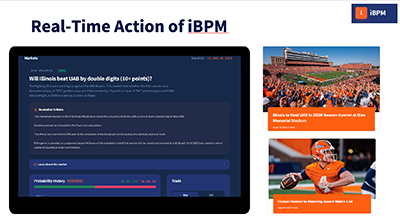
To make things fun, students will be able to earn badges, while a leaderboard will allow them to gauge their performance. That’s an important component, according to Excell.
“In all the investment and trading challenges we do in the Derivatives and Trading Academy, there’s always a leaderboard, because it helps students understand where they rank and shows employers how well they’ve done,” said Excell. “If you’re in the top 10 out of thousands of global student teams, companies want to interview you, and you can speak to that.”
The project is a collaborative effort, with Illini Blockchain doing the technological build-out, the Disruption Lab controlling and maintaining the blockchain, and students in the academy acting as the market makers and prop traders. The exciting collaboration is emblematic of a program that’s always pushing boundaries.
“The entrepreneurial nature and culture at Gies Business is very impressive, maybe more impressive than a lot of the hedge funds that I worked at,” said Excell. “I think we’re the only school that has a Derivatives and Trading Academy and our own blockchain. And now we’re the only school with a prediction market. When students get out there to sell their brand and their resume to companies, they’ll have some things that they’ve done here that others don’t.”
That’s as true for the students building the app as it is for those using it. “It’s been a great learning experience, making this from scratch and seeing that we can bring it to life,” said Bedi.
Beta testing began earlier this semester and will continue throughout the fall. If all goes according to plan, the iBlock Prediction Market will open to all Gies Business students starting in January. As for when Altmyer will adjust his hairstyle, the date is still unknown. But if you’d like to get in on that action, you’re welcome to place your bet.