Drawing on his experience as a professional auditor, Ben Van Landuyt uses experimental research to explore auditors’ decisions and teaches students how to navigate accounting’s real-world gray areas.
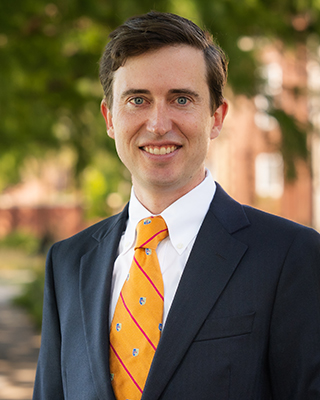
Ben Van Landuyt joined Gies College of Business this fall as an associate professor of accountancy and KPMG faculty fellow. Van Landuyt is a scholar of accountancy whose research explores the human and systemic elements of financial reporting and auditing.
Before heading to graduate school at the University of Texas at Austin, Van Landuyt spent three years as an auditor at PwC. That experience gave him a window into the relationships that inform the actual, on-the-ground experience of auditors.
“Working as an auditor was a great experience and a natural area to focus on as I started learning more about accounting research in graduate school,” said Van Landuyt. “I had seen what auditing looked like in practice, and I had seen firsthand the interplay between auditors and the people they are auditing.”
That's part of what makes Van Landuyt's perspective unique. He pays attention to the larger system that informs the human interactions underlying financial reporting. That inflects his scholarship with a disposition toward thinking of accounting as something with a purpose: serving people.
“Accounting lends itself well to understanding where the human element and the financial element intersect,” said Van Landuyt. “Accounting researchers tend to do a good job integrating these two ideas. Maybe that’s because of the unique nature of what accounting is. It is numbers; it’s financial information, but it’s information that’s intended to serve a purpose for the people that use it.”
Understanding Audit Decisions with Research
Van Landuyt's research reflects that awareness of both the people and the data that make accountancy what it is. As he tells it, he explores how the relationships and interplay between elements in a system shape that system as a whole. He's studied, for an example, how auditor-client negotiations change when those clients take up ESG activities or pro-social causes.
“On the auditing side, it’s not just, ‘What are the auditors doing to verify a number?’ It’s, ‘How are the auditors strategically interacting with the managers they’re auditing?’” said Van Landuyt. “How does the interplay between those two parties shape the outcome of what number eventually gets reported? And then how are investors and other stakeholders going to react to that outcome?”
Answering those questions requires experimentation. Van Landuyt's studies have included testing to see how a change might shape judgments - a detailed hypothetical case can be used to give participants context and isolate their choices.
“I do experiments. I construct controlled settings and manipulate elements of those settings to see if those changes make a difference in the way people respond,” said Van Landuyt. “The research question is always important in informing exactly how you construct those settings. Sometimes it can be really contextually rich, almost like a case study that provides vibrant detail about a hypothetical situation to measure how auditors, investors, or managers would respond.”
Van Landuyt also utilizes techniques from experimental economics: leveraging settings in which participants make decisions in abstract, game-like situations with real monetary payments attached. Pairing economic theory with psychological insight and accountancy expertise allows him to observe how real behavior holds up next to the models when actual financial incentives are involved.
Teaching Students the Human Side of Auditing
Before joining Gies Business, Van Landuyt taught at the University of Arizona. At Illinois, he'll teach graduate auditing, helping prepare students in the MSA program for work that requires both technical knowledge and careful decision-making. Working as an auditor or an accounting professional involved in financial reporting necessitates working comfortably in situations that may be incomplete or difficult to sort out. Van Landuyt sees this as an opportunity.
“The master’s program is a great opportunity to start introducing students to the idea that, when the rubber meets the road, these are the accounting or auditing rules, but there’s still a lot of subjectivity in interpreting them," said Van Landuyt. "There’s also subjectivity in the underlying information you might have or in understanding how the rules apply to that information. Those gray areas create really interesting problems, and some of those problems are things we study through our research. It’s a perfect opportunity to introduce students to what we’re learning as researchers that is relevant mitigating the problems that arise in practice, which can hopefully help lead to better outcomes.”
It's both a practical and academic approach to instruction. Students can encounter problems, learn about what experts have to say in the area, then eventually apply that learned wisdom to their professional practice. Just knowing that process exists can be its own reward down the road. Van Landuyt's own education taught him that it's much more important to learn how to ask good questions and find good answers than it is to memorize correct answers. Those answers might change, but the reward of learning how to learn and solve unique problems will never fade.
An Illinois Connection
His move to Illinois also brings Van Landuyt closer to a community and tradition that's already shaped his career - including the work of late professor Jessen Hobson. Van Landuyt and Hobson shared an advisor, making them a kind of academic siblings.
“Jessen [Hobson] in particular was such an early encourager in my career," said Van Landuyt. "He was a source of positivity and encouragement, and someone I learned a lot from as well. It feels special to be here doing similar types of research. To follow a little bit in the path he took is really meaningful to me.”
Van Landuyt's connection to campus goes beyond personal regard - Illinois' excellence in accountancy attracted Van Landuyt to the role.
“I was thinking about these Illinois connections that had already shaped my career, and I realized that this story probably isn’t unique to me," said Van Landuyt. "That’s something so cool about Illinois: In accounting, it truly is at the forefront of what we’re doing as a discipline. There are people throughout the country and throughout the world in our profession who have been positively influenced by things that started here and by people who taught here or were trained here or have been associated with Illinois. The chance to be in a place where you can potentially have that kind of positive impact, carry that forward, and be part of that environment is really exciting.”