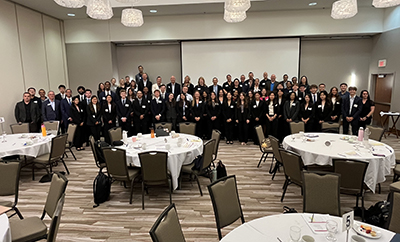
The Supply Chain Management (SCM) Program at Gies College of Business hosted its 8th Annual Industry Day on September 12, bringing together students, faculty, and corporate partners for problem-solving, networking, and career discussions.
The Supply Chain Management (SCM) Program at Gies College of Business hosted its 8th Annual Industry Day on September 12, bringing together students, faculty, and corporate partners for problem-solving, networking, and career discussions.
Highlights included a hands-on brainstorming session on a real-world supply chain challenge, an industry panel offering career guidance, and opportunities for students to connect directly with employers. Rural King, the program’s newest partner, invited students to help address one of its most pressing supply chain issues in 2025.
“Industry Day is an opportunity for our students to meet with our corporate affiliates and for them to hear some of the supply chain challenges and decisions experienced by our affiliates,” said Gopesh Anand, professor of business administration at Gies. “It provides all supply chain students with the opportunity to reflect on how those decisions can be similar or different across various industries.”
Representatives from the program’s five corporate partners – Caterpillar, Echo Global Logistics, Horizon Hobby, OSI, and Rural King shared opportunities for internships and careers within their companies and advised how Gies Business students can be successful in the field.
Larry Stefanski, Senior Manager – Parts Inventory Collaboration Unit, Caterpillar, has a unique perspective as a graduate of the program. He was also recognized during the event as a Distinguished Alumnus for his continued support of the Supply Chain Management Program since his graduation.
“We are here because we want to have more Gies students working in our rotational programs within our supply chain and inventory management space,” Stefanski said. “The Supply Chain program at Illinois develops problem solvers. It prioritizes optimization. It focuses on perfecting processes. It’s a way of thinking that it has had for decades now, which is its power. There are a lot of supply chain programs out there teaching very similar curricula, but Gies does a better job of teaching students how to solve problems and be critical thinkers. As a result, this is a group of students that’s important for Caterpillar to continue to recruit.
In his opening remarks, Carlos Torelli, Anthony J. Petullo Professor of Business Administration and head of the Department of Business Administration at Gies Business, shared a similar sentiment.
“Students with critical thinking skills who can solve problems are valuable to top companies,” Torelli said. “We give you a chance for experiential learning where you can solve real problems.”
Headquartered in nearby Mattoon, Illinois, Rural King is the largest privately owned farm chain in North America. It was founded in 1960 and has 149 stores, mostly east of the Mississippi River.
“As a growing company, we are always looking for the opportunity to create what I would call a feeder system,” said John Leonauskas, Executive Vice President of Merchandising at Rural King. “One of the hardest things to do is find good people, especially because we are not in an urban center. We want to really lean into and take advantage of this great resource in our area, the University of Illinois, to help meet that need.”
For 90 minutes, Leonauskas gave smaller groups of faculty, students, and industry partners a chance to brainstorm on a real-world problem Rural King is facing in 2025, dealing with the reality of new tariffs.
He shared that Rural King purchases around $111 million of foreign goods, 35 percent of which come from China. The year brought uncertainty about how tariffs were going to be implemented and the potential for retaliatory tariffs from other countries. Each team was given 30 minutes to come up with ideas, and after praising those ideas, Leonauskas shared that Rural King was using some of the suggested strategies already – sharing costs with freight companies and vendors, moving some of their seasonal décor dollars, deciding to purchase goods from other countries or domestically, being open with customers about the challenges through marketing and messaging, and in the end absorbing some of those costs.
Following an affiliates panel, all parties had some time to network.
“What I hear from the industry partners is that they like the chance for comparison and contrast that they get with the other corporate affiliates here,” Anand said. “They also like the kind of questions students ask, which gives them fresh eyes on the issues that they are tackling. As faculty, we also get some ideas about where we can enhance the curriculum for our students.”
Abby Allen, a senior from Naperville, Illinois, double majoring in supply chain management and information systems, participated in her second Industry Day and says that the event often is a launching point for future opportunities, such as attending a symposium, which she did last year because of Industry Day.
“Networking has been super helpful in giving me insights into different roles within the supply chain,” Allen said. “We get to talk about factors that impact different industries, and gain exposure to problems that are facing corporate America, that we may not get to in class.”
“This is one of the most impactful events of the year because everyone is here,” said Hongyan Liang, senior lecturer of business administration and director of the Supply Chain Management Corporate Affiliates Program. “Whether it is affiliates working with faculty or with students, these events make it happen. The students enjoy this opportunity to network with high-level managers. They are also connected first-hand with career opportunities.”
In addition to welcoming partners and students, the event also included remarks from Mili Mehrotra, Academic Director of the Supply Chain Management Program. As part of Industry Day, she shared updates on the state of our undergraduate SCM major and highlighted how the SCM major curriculum continues to evolve to meet the demands of a rapidly changing field. “This event is not only about networking and problem-solving—it reinforces our mission to connect classroom learning with industry practice and ensure our students graduate ready to lead,” said Mehrotra.
In looking ahead, Mehrotra added, “My goal is to continue building on the momentum of Industry Day by expanding industry collaborations, enhancing experiential learning opportunities, and further strengthening the supply chain management major so that our students remain at the forefront of the profession.”
In his closing remarks, Gautam Pant, Area Chair, Information Systems, Operations, Supply Chain, and Analytics (IOSA) at Gies, highlighted the impact of the event and the connection between research and practice.
“It was great to witness another successful Industry Day that brought our students, faculty, and corporate affiliates together to tackle real supply-chain challenges, and I encourage supply chain students to explore our new Business Analytics minor as analytics will be key to true diversification and better risk measurement in global supply chains,” Pant said. “The event also highlights how academic research can inform industry practice, and I urge faculty to deepen these collaborations to keep our scholarship relevant and directly benefit our students.”