In the last five years, Gies has masterfully designed a suite of stackable educational degrees, where students can take a course and then apply that credit to the College's highly regarded iMBA or other certificate programs.
Gies College of Business has become known around
the world as an innovator — a college that takes big
risks with its creative academic programming. In the
last five years, Gies has masterfully designed a suite of
stackable educational degrees, where students can take
a course and then apply that credit to the B-school’s
highly regarded iMBA or other certificate programs.
Now Gies is hoping to take its expertise in
stackability and apply it to other graduate programs
at the university, announcing new cross-campus
collaborations with the University of Illinois Urbana-Champaign’s agricultural and medical schools. It is a
big step forward for the business school, enabling it to
reach a whole new population of students on campus, says Amanda Brantner, Gies’ director of content and
educational portfolio strategy.
“As a university, we have tremendous expertise in
areas outside of business that are business adjacent,”
Brantner says, “and we want to be able to serve our
graduate degree learners with content from other
colleges across campus. We see a large opportunity
to support the goals of learners in areas like healthcare
and agriculture through our certificate programs.”
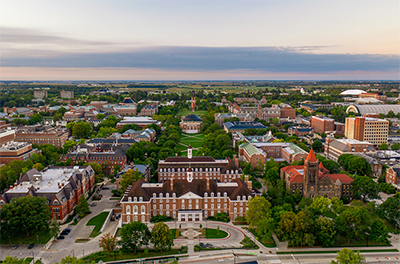
A natural partnership forms between Gies and agriculture faculty
Gies’ first foray into cross-campus collaboration
is a partnership that launched in August with the
university’s College of Agricultural, Consumer and
Environmental Sciences (ACES). This new program, the
Agribusiness & Sustainable Food Production Economics
graduate certificate, will allow students to take four
courses focused on agribusiness and sustainable food,
or 12 credit hours in total. Students who take these
courses – which have been developed and delivered
by the ACES faculty – can also choose to use them to replace one of the focus area requirements in Gies’ online MBA. As an added benefit, they are also stackable into
Gies’ portfolio on online graduate degrees.
This graduate certificate will provide learners
an overview of global production and distribution of
agricultural commodities and food products. Learners
will examine the financial and risk-management
decisions associated with agricultural production and
analyze modern issues facing the food industry in light
of global challenges to sustainably feed a growing world
population, Brantner notes.
The MOOCs for these classes will serve as the
“digital textbook” and foundational content for the
for-credit courses, Brantner says. The collaboration
with the agricultural school made sense for Gies’
first cross-campus collaboration to expand its online
stackability model given that the University of Illinois
is a land-grant institution in the heart of central Illinois,
Brantner notes. The courses being offered as part of the
program include: Supply Chain of Agriculture, Issues in
Supply Chain Management, Risks to Crop Production in
Agriculture, and Strategies and Tools to Mitigate Agricultural
Risk.
“We are a go-to-institution for individuals in the
agricultural industry, and we believe that by partnering
with ACES we can support learners who want to pursue
graduate education in a combination of agriculture and
business to further their careers and provide upward
mobility,” Brantner said.
Indeed, there is much potential for Gies to expand
its reach at the university, and as a result attract more
students who may eventually want to do the iMBA or
other degree programs the College offers. The university as a whole has a robust graduate school
population that Gies can tap into: Just this past fall the
university welcomed 7,425 new graduate students, one
of the largest cohorts in its history.
Collaboration with College of Medicine in the works
Gies also has plans in the works to create another
new graduate certificate with the Carle Illinois College
of Medicine. This certificate program will be called the
Healthcare Innovation, Design and Entrepreneurship
Graduate Certificate, and will be stackable to all
Gies online degrees. The collaboration has support from the Mayo
Clinic and the Siebel Center for Design, and it will focus on innovation in healthcare, giving learners insight into
product development and the entrepreneurship skills
needed to bring new healthcare products to market. The Gies faculty who have developed
the courses are experts in operations management, new
product design, and development and entrepreneurship, and many of them have joint appointment between Gies
and the Carle Illinois College of Medicine. Gies expects
to have the MOOCs for the program ready for launch in
the spring of 2025, followed by credit-bearing courses
and eventually the stackable graduate certificate.
“We’re expecting more demand, at least initially,
for the healthcare certificate because we expect to
have a longer timeline marketing and promoting it
to our students,” Brantner says. “It will leverage Gies
faculty and their expertise in the areas of innovation
and entrepreneurship.”
Collaboration expands existing relationship with medical school
The program builds upon an already established
partnership Gies has with iMBA students from the
Carle Illinois College of Medicine and the Grainger College of Engineering.
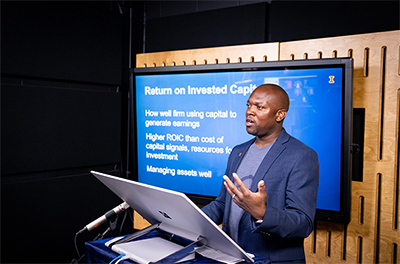
Ravi Mehta, a professor jointly appointed with Gies Business and Carle Illinois, heads up Capstone Innovations, the year-
long, hands-on project that students collaborate on
together. The cross-disciplinary team of students who
participate come up with new prototypes and ways
of doing things that have the potential to change the
practice of medicine in some fields as well as improve
medical outcomes.
For example, one of the 2024 capstone projects is called Spinal Vision, and defines a new image-guided
system that allows clinicians to perform challenging
lumbar puncture procedures in a safer manner, and
with less pain for the patient. Another project students
developed is BRACA, which improves the function
and usability of the post-surgical compression bra for
those who have had a mastectomy.
“Innovation is not complete unless it serves a need
and people adopt the product,” Mehta says. “Business finds that need, finds the niche, helps bring
it to people who need that technology the most. And
that is what innovation is. Without business, it’s just
an invention. Business is what makes it innovation.”
Innovation is a strong driver for Gies
Indeed, innovative work like what Mehta does
with his students is key to Gies’ mission, and part of
why Gies wants to expand its footprint on campus,
Brantner says. She is eager to see how these cross-
campus collaborations play out in the next few years,
and believes they will be popular options for graduate
students across campus. It has taken several years to
develop each of these graduate certificate programs, to
ensure that the new courses meet leaners’ expectations
and are delivered in a consistent way, not an easy feat
by any means, Brantner says.
“Interdisciplinary collaboration on a campus of our
size is of great interest and is a strategic priority for the
campus, but it is very difficult to actually get done,” she
says. “This is about creating access, and as we embark on collaborations with others across campus, we will
continue to stay true to that mission-driven focus.”