Shubhendru Johri's trajectory – from a technical specialist in India to an Engagement Manager at KPMG in London – serves as a masterclass in how to bridge the gap between technical “how” and strategic “why.”
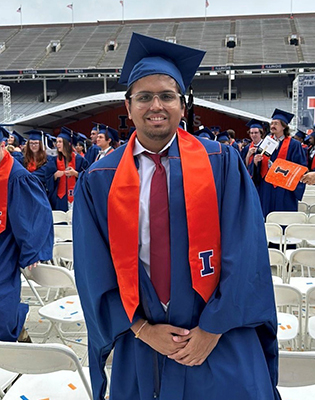
For Shubhendu Johri (MSTM ’23), the catalyst to pursue an advanced degree appeared in an EY Consulting boardroom. While senior stakeholders debated the future of a massive transformation project, Johri realized his technical expertise alone wasn’t enough to secure him a seat at the strategy table.
“My role was limited to explaining the technical risks, and that became the turning point,” said Johri. “It hit me that if I wanted to shape decisions, not just react to them, I needed a broader understanding of business.”
That realization led Johri to the Master of Science in Technology Management (MSTM) program at Gies College of Business. His trajectory – from a technical specialist in India to an engagement manager at KPMG in London – serves as a masterclass in how to bridge the gap between technical “how” and strategic “why.”
Johri chose Gies Business for its elite reputation and a curriculum designed to evolve alongside the industry. The MSTM program offers a blend of tech-forward subjects – like information systems and enterprise resource management – with the foundational strategy found at a world-class business school.
The impact of this immersion was immediate. While completing the one-year program on campus, Johri turned an internship into a part-time paid position at Graybar Innovation Lab at the University of Illinois Research Park. As a project manager, he acted as the vital link between software engineers and customer solutions.
“I was applying concepts from class in real time,” said Johri. “But what really changed my mindset was the feedback.”
During one class presentation, a professor pushed him beyond technical excellence.
“They told me, ‘This is strong technically, but what does it mean for the business?’” said Johri. “That question stayed with me. Over time, I learned to lead with outcomes and impact instead of leading with technical detail.”
Navigating a global career
Johri appreciated how dynamic and responsive the curriculum was to industry trends such as blockchain technology and digital transformation. He also valued the Gies MSTM program’s emphasis on developing soft skills in communication, storytelling, and networking.
"Before Gies, networking felt very transactional, but now it comes more naturally,” said Johri. “Conversations with alumni have turned into mentorship, referrals, and long-term professional relationships."
After graduation, Johri joined EY Consulting in Dallas to support projects in the technology, media & telecommunications (TMT) sector across San Francisco, Los Angeles and Seattle. In his role as a manager, he focused on identifying and managing technology-driven risks that affect business performance and resilience.
When his US work authorization approached its end, Johri faced a familiar inflection point—one that required both preparation and perspective. This time, however, he leaned on the alumni network he had intentionally built.
“Before I accepted my current position, I reached out to an alum who helped me understand the London work culture,” said Johri. “Having a global brand name like Gies Business on my CV made it much easier to position myself for international hiring. Many of my classmates have had similar experiences, securing positions globally.”
Today, Johri is an engagement manager specializing in Cybersecurity – Mergers & Acquisitions for private equity clients at KPMG’s London office. He evaluates the scalability, integration complexity and investment trade-offs of a deal – a role that requires a seamless blend of technical expertise and advanced business skills. This career pivot has translated into a nearly 75% salary jump from what he was earning with his bachelor’s degree in technology in India.
“If you lean into what the program offers, it can genuinely reshape how you think and lead," said Johri, who advises prospective master’s degree students to look beyond the credential and identify the specific skills they want to develop.
“Don’t think of as a master’s degree as a checklist item for your resume,” he said. “If you’re looking to grow your career beyond technical expertise, carefully assess how a school’s specific offerings will grow your career, then commit to fully immersing yourself into the experience.”