Gies Business students use agentic AI and multi-agent systems to build trading platforms, analyze markets, and gain finance skills for an AI-driven future.
Gies College of Business is reimagining how students learn to interact with the financial markets.
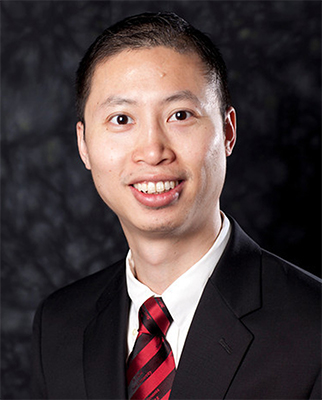
“Our students have to compete with the real market at a time when financial systems are adapting to AI at light speed,” said Clinical Assistant Professor Tony Zhang (right), who teaches FIN 580: Quantitative Investment at Gies Business. “This is making textbooks and standard Q&As obsolete in the classroom because students can throw any static question into an LLM [Large Language Model] and get an instant answer.”
This course’s real-market focus means shifting from passive data consumption to active AI engineering. Students create institutional-grade dashboards, and AI agents autonomously translate those designs into code. They also learn how to use agentic tools to scrape and verify data like interest and retail sentiment that traditional terminals might miss. Zhang says agentic AI makes complex programming accessible and less intimidating to students who are hesitant to do hands-on coding. Using free agentic development platforms like Google Antigravity, students can tackle weekly assignments that once took a full semester to complete.
Teaching Students to Manage AI, Not Just Use It
For recent graduate Agata Fietko (MSBA ’26), the power of these AI tools took center stage during her final project: A live, multi-agent platform designed to trade based on narrative signals scraped from the news.
“We got to take all that knowledge and use Google Stitch to create a visually strong, fully functional platform for AI agents to trade for us,” said Fietko.
Yet, she believes that AI is given far too much credit for how it operates.
“A lot of people miss that the word intelligence in artificial intelligence is very misleading,” said Fietko. “People assume there’s an actual thought process. But what I learned in this course is that human expertise is essential for supervising and effectively using AI tools.”
Experiences like these reflect a broader shift in how Gies Business is preparing students for the future of work. As AI becomes embedded in business operations, competitive advantage will come not from simply using AI tools, but from knowing how to direct and orchestrate them effectively. Students are learning how to design workflows, evaluate AI-generated outputs, and make informed decisions when information is incomplete or uncertain. In other words, they are developing the judgment needed to lead in workplaces where humans and AI increasingly work together.
Indeed, the speed of agentic AI comes with a big caveat: It makes mistakes. Throughout the course, Zhang reminds students that 95% to 99% of financial news and statements are now AI-generated, making error detection a core professional skill.
“AI can produce all kinds of false information without being noticed,” said Zhang. “We’re teaching students that their job as professionals – and the reason they won’t be replaced by AI -– is their capacity to identify which part of the data is reasonable and which part is not.”
To bypass the risk-averse nature of a solitary LLM – which often stalls when data points are missing – students collaborate with multi-agent frameworks that mirror a human brainstorming session. By building distinct agents assigned to isolated tasks like valuation, risk, and alternative data collection, the specialized AI units learn to cross-examine one another and collectively troubleshoot errors.
Inside the Multi-Agent Systems Powering Student Investment Strategies
“AI agents would challenge each other regarding the decision they made,” said Allen Li (MSBA ’26). “They learn from each other and correct the mistakes they've made. Through thousands of back-tests, my multi-agent system successfully generated a 15% rate of return in less than a month.”
Li said he learned how to address the risk-averse nature of agentic AI, which often shied away from the discretionary power he gave it to make choices by responding that it did not have enough information. He estimated that he spent about 50 hours over three weeks fine-tuning errors made by the multi-agent system.
Xinying Fu (MSBA ’26) says she was taught how to de-mystify the ‘black box’ aspect of multi-agent AI solution development.
“Understanding the work behind multi-agent building is easy if you have a coding background, but working as an AI designer is different,” said Fu. “We learned that you need to design a clear map of your layers beforehand, because AI generates its own thinking. If you don’t make the workflow clear, the ‘black box’ won’t tell you the answer when things go wrong.”
Fu used this structured approach to simulate five distinct AI hedge fund agents, stress-testing trading strategies against live macroeconomic disruptions like Consumer Price Index surprises and sudden oil spikes. It is exactly this kind of advanced application that she will explore as a doctoral candidate at Temple University’s Fox Business School this fall.
Zhang says the goal is to evolve the Gies Business finance curriculum to give graduates a distinct advantage in their job search.
“By interacting with an active network of quantitative investment alumni placed at top-tier firms like Goldman Sachs and major hedge funds, students realize they are entering the job market with skills that outpace industry professionals who graduated just a few years ago,” said Zhang.