PowerBox is designing an architecture that enables growth, the ability to scale to different dimensions, and that can universally convert and work with new energy sources.
By Mike Koon
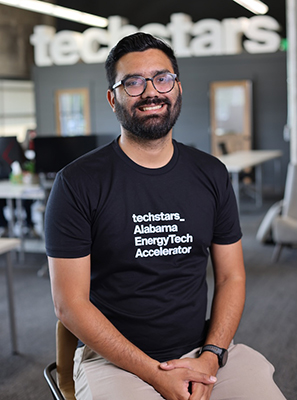
A native of Costa Rica, Oscar Azofeifa moved to the United States, hoping to become an entrepreneur. After playing a big role in the early stages of a startup, Azofeifa set out to start his own company from scratch. Over the past two years, he has founded PowerBox Technology, a company that develops and optimizes energy systems for medium-sized factories, offices, and data centers. He chose to headquarter his startup in the University of Illinois’ Research Park and pursued an MBA degree through Gies College of Business, from which graduated in December 2025.
All the pieces of his early career have fit like a glove, including his decision to return to Champaign-Urbana, where he had completed a Master of Engineering in Energy Systems from The Grainger College of Engineering in 2018.
“I always knew this was a great place to innovate in deep tech and R&D with an amazing pool of talent and connections to not only the Midwest, but also the world,” Azofeifa said on his decision to move back to Champaign in 2023. “I pondered the idea of going to Chicago directly because my wife is from there, but I told myself, ‘Why would I go to Chicago when I have everything I need right here in Champaign and for a fraction of the cost?'”
Although he knew of the U of I’s reputation for developing startups, that wasn’t the focus of Azofeifa’s first tour on campus. At the time, he was hyper-focused on research, helping a professor with transportation projects for both the Department of Energy and the National Science Foundation. After completing his first master’s degree, Azofeifa was recruited as a microgrid engineer for Heila Technologies, a fledgling Boston-based company that set out to simplify the integration and operation of distributed energy resources (DERs) and microgrids as a new approach to energy. Kohler, seeking to expand its toolbox of clean-energy solutions, acquired Heila Technologies in 2021.
“That was a success story because even though I wasn’t a part of the company when they were acquired, I saw almost the whole process from very early until it finally evolved into a company that could be an acquisition target,” Azofeifa said.
After a decade in the energy industry, Azofeifa was ready to take his own innovation to the marketplace. He enrolled in Gies’ fully online iMBA program, and he and his wife bought a house in Champaign. PowerBox secured office space at EnterpriseWorks and built a laboratory in the Center for Power Optimization of Electro-Thermal Systems (POETS), both within the University of Illinois Research Park. In 2024, he was accepted into the iVenture Accelerator for the top student startups at the University of Illinois. iVenture is part of Gies’ Origin Ventures Office of Entrepreneurship, which supports entrepreneurial activities of both on-campus and online learners.
PowerBox is targeting a segment of the energy world that Azofeifa says has been underserved – factories, small-scale data centers, hospitals, and commercial buildings.
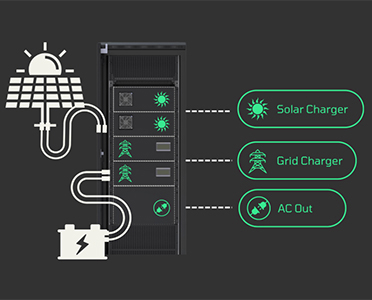
“I believe they would be the focus of the next iteration of energy technologies because the cost of the current systems was too high for this segment,” he said. “I knew we had to reinvent or redesign these architectures and the technologies a little bit to satisfy these other markets.”
As new technologies are emerging, such as wind towers that fit on a single building, biogas, and hydrogen, PowerBox is designing an architecture that enables growth, the ability to scale to different dimensions, and that can universally convert and work with these new energy sources.
“The consumers that we are targeting worry about two things: up-time (things never go down), and cost,” Azofeifa said. “In that context, we are designing a system and working with early adopters on a large-scale implementation and more manufacturing capacity to satisfy the market. That solution hasn’t previously existed.”
For now, PowerBox is helping energy suppliers with solutions they can, in turn, implement for their clients. Azofeifa has spent the past three months at the TechStars Alabama EnergyTech Accelerator in Birmingham as part of a $220,000 development grant from Alabama Power. They are setting up a pilot for the software and building a commercial pipeline in the state. Azofeifa indicates that a research center is already interested in the technology.
“We have investors who are helping us in the development and manufacturing process and providing us connections to early adopters,” he said. “Energy companies want to provide solutions for factories and data centers and benefit from having us in their toolkit.”
In two short years, Azofeifa has built a team (currently a team of eight), more than half through U of I contacts, including Azofeifa’s former advisor, Magnus Anderson, as chief operating officer. He has developed the technology, secured the first few rounds of funding, and identified clients while putting his MBA degree to good use.
“The experience with Gies has been amazing because I had the flexibility to decide the order in which I took classes,” Azofeifa said. “I developed my tract in parallel with building the company and have immediately started applying what I learned.”
For instance, accounting courses served as a foundation, and innovation strategy offerings were instrumental in building an understanding of how to attract investors.
“Since the program has that flexibility, he said, “it doesn’t matter if you are a founder like me, or if you want to be an investor, or go into mergers and acquisitions or consulting; there are infinite ways that you can design the program to adapt to what you want to do as a professional.”