Gies Business is a fitting next step for a scholar like Hannah, whose research focuses on strategy and entrepreneurship: how people organize to have an impact.
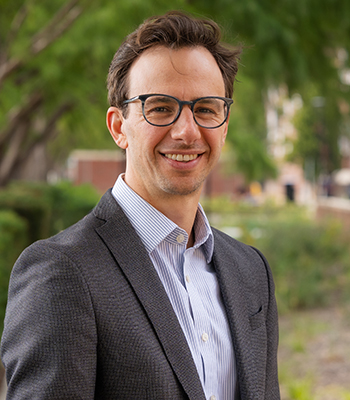
Douglas Hannah has always been building things. Whether it's an organization, a
research project, or a mountain biking club, he loves tinkering with new ideas.
"I've always been in situations where I'm working with
people to do things and build things," he said. "Sometimes that's as an
entrepreneurship researcher and teacher, sometimes it's in venture settings,
but oftentimes it's in all of the different organizations that make our lives
and society work."
This fall, Hannah
joined Gies College of Business as an associate professor of business
administration. Hannah earned his PhD in Management Science and Engineering at
Stanford and has held faculty positions at the McCombs School of Business (UT
Austin) and Questrom School of Business (Boston University). Gies Business is a
fitting next step for a scholar like Hannah, whose research focuses on strategy
and entrepreneurship: how people organize to have an impact.
"Entrepreneurship, for me, is about understanding how people
come together to create change in the world," he said. "It's about
how they work together, and how they turn what's in their heads into real-world
impact."
That interest has taken him into industries and organizations amid
transformations. Hannah has studied the rise
of social media and the advertising industry, the
rapid growth of the solar industry, and more. For him, moments of
disruption are rich ground for academic study.
"In moments of change with new possibilities, you have this
brief window where, if you act, you can do something incredible," Hannah
said. "But you also might have no idea of what you're supposed to do, and
you have no idea if it will even work. And you need to figure it out -
quickly."
Hannah is drawn to those times of emergence and disruption
because they're rich with possibility and ambiguity. They're also great
examples of where his preferred methods shine. While most of his work relies on
field research, he also draws
on modeling and insights from fields like economics and psychology.
"I'm a field researcher. I go into organizations, I observe,
I interview, I collect data, and I try to abduct patterns about what's going
on," he said. "Fundamentally, my job is to explain new
phenomena."
His hands-on approach to research reflects a broader commitment:
that research should be useful and accessible.
"I enjoy just knowing, taking things apart to see how they
work just for the sake of understanding," Hannah said. "But a part of
my work I'm proud of is understanding what we can really do with my research.
Someone should be able to pick up even one of my papers and say: I understand
this better."
Practicality and openness also shape how he works with
colleagues. A collaborative and interdisciplinary culture was a factor in his
decision to join Gies Business.
"Research is not a solitary activity for me," he said.
"I'm always in the office, interacting with colleagues, because this is
the kind of job where you can sit alone and do a lot of thinking. But I'm a guy
who wants to talk through things. I want to learn from people, find the
interesting angles between what we work on."
Beyond its collaborative environment, Hannah was excited to join
Gies' culture of innovation - particularly its approach to rethinking models of
education. And Hannah is jumping right in, teaching in Gies' fully online MBA program - the iMBA. He co-teaches MBA 553, a core entrepreneurship course,
which reaches more than 700 students each semester.
"What excites me about Illinois isn't just that it's making
education more accessible, but it's also rethinking what education can be, and
how it fits in students’ lives. They can apply what they learn immediately.
Thousands of students still working, progressing their career paths, taking
what they're learning on a Thursday morning and putting it into action in their
companies or lives on a Thursday afternoon."
That focus on expanding access to quality business education was
a perfect match for his own research interests - an institution at the front of
a changing field for a researcher who specializes in studying moments of
change. He's at home in the unknown: a market in upheaval, a fledgling
organization taking shape, an educational system in transition.
"Illinois is out in front in this moment," he said.
"The opportunity to join that, you can't turn that down when it
comes."